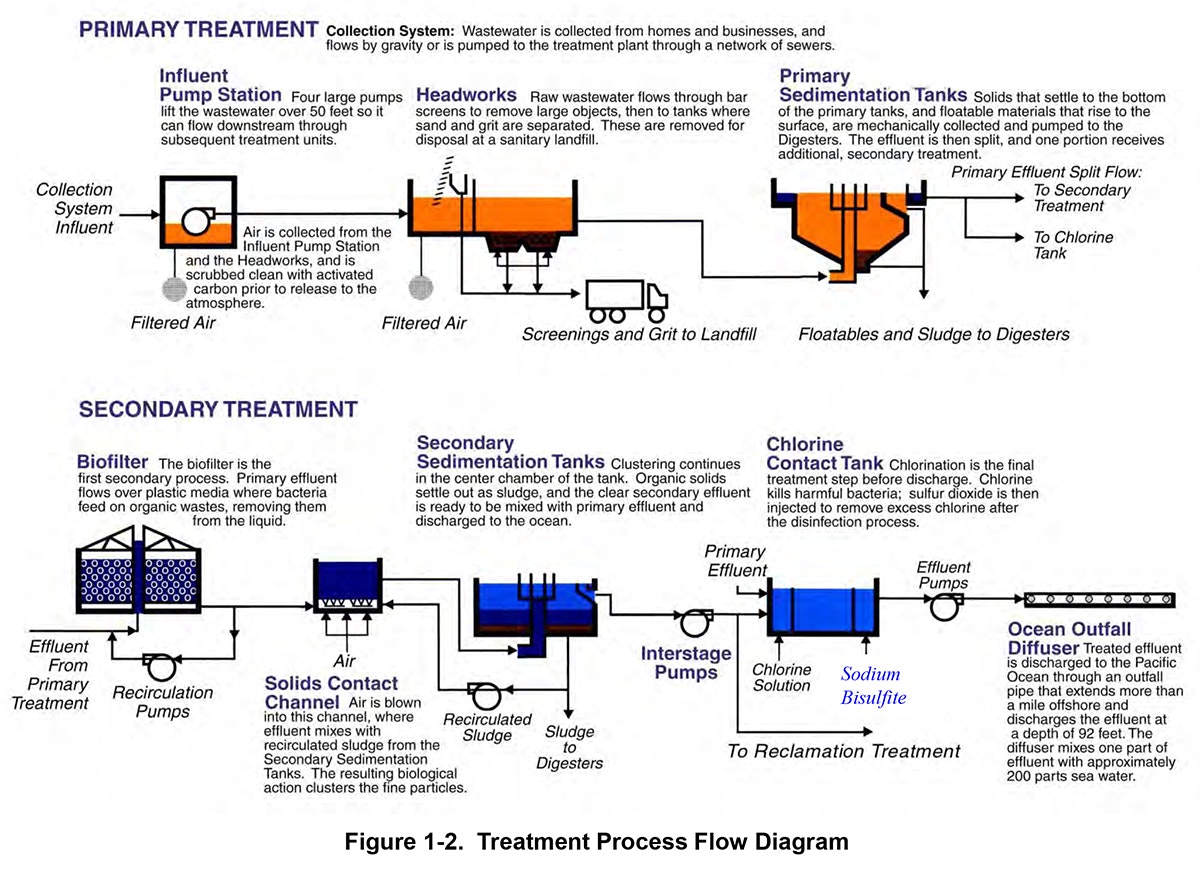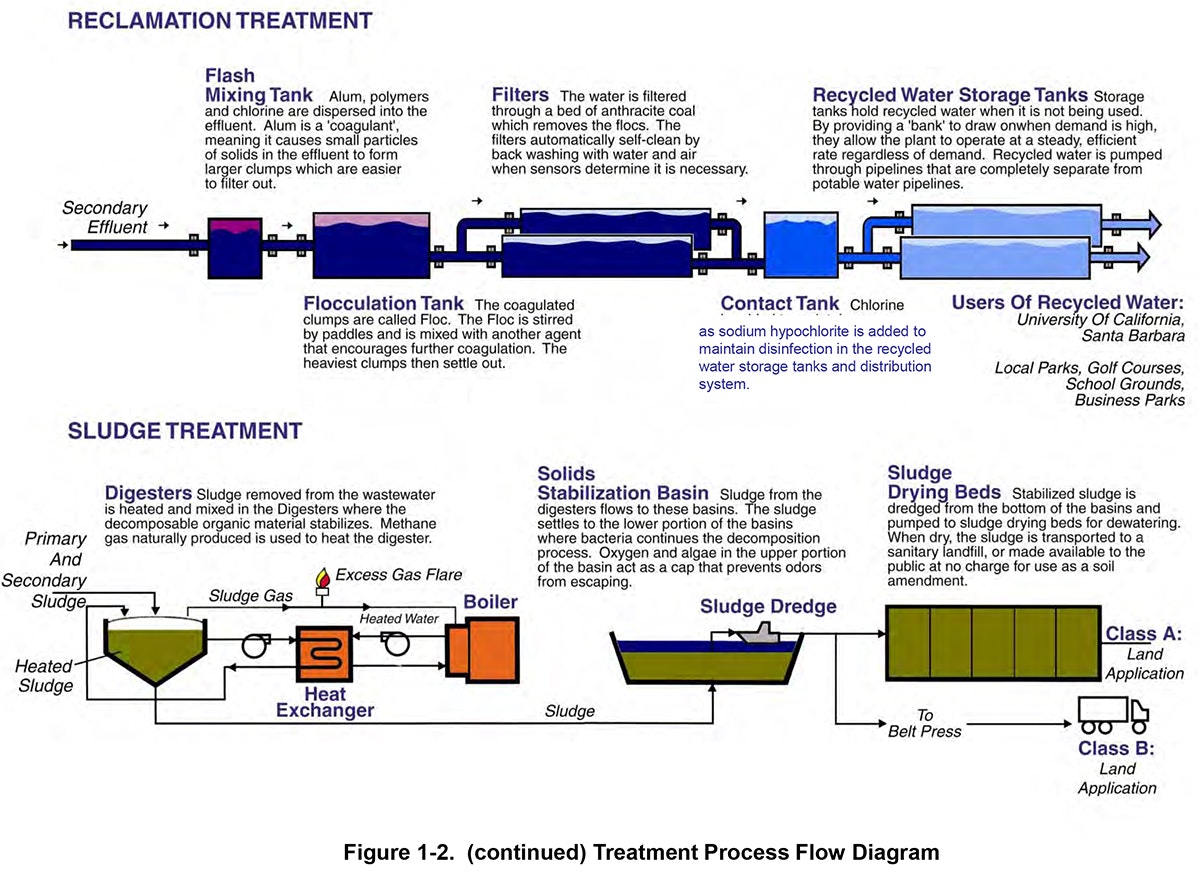
Wastewater Treatment: Follow the Flow (Chart)
Introduction
Our mission is to protect public health and the environment through the collection and treatment of wastewater, and to recover valuable resources such as nutrients, energy, and of course, water. Our treatment efforts involve treating wastewater to beyond mandated levels of cleanliness before releasing the treated water that is not recycled for landscaping to the ocean. We focus on finding the most innovative and safest ways to do this in a cost-effective manner.
We use three treatment processes: physical, biological, and chemical to achieve our mission. Each step below reflects one or more of these treatment types.
Preliminary Treatment
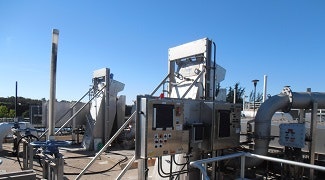
The wastewater treatment process begins with two micro-screen units that remove large and small inorganic objects, including so-called "flushable" wipes, plastics, wood, and more. Then two grit chambers with coarse air bubble diffusers slow the flow so that small heavy inorganics such as coffee grounds, eggshells, and rocks to drop out and are removed. Wipes often must be removed by hand, as they can severely damage the equipment. Wipes and other inorganic material collect in a dumpster before transport to a landfill.
Primary Treatment
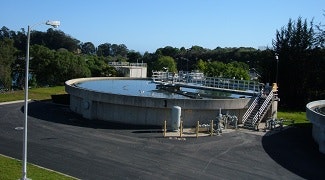
The primary treatment process is a physical process that uses gravity to remove about 69% of the organic solids from the wastewater.
Our primary treatment process consists of the screened sedimentation tanks, in which solids that settle to the bottom, known as sludge, or float to the top, known as scum, are collected and removed from the water.
Secondary Treatment
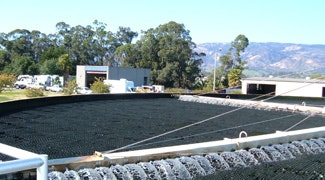
The secondary treatment process is a biological and physical process that removes about 85% of the remaining solids from the wastewater. Primary-treated wastewater is sent to the secondary treatment process, which begins with two biofilters, where microorganisms consume the dissolved organic material in the wastewater. As they grow, they become too heavy to stay on the plastic media and slough off. After biofiltration, the water flows by gravity to the three activated sludge basins where the further biological activity breaking down more organic material. The water then proceeds to two of four secondary sedimentation where solids settle to the bottom for removal. This stage duplicates the primary sedimentation tank process. The clear surface water flows over weirs as secondary-treated effluent.
Effluent Discharge
The secondary-treated wastewater then proceeds to the chlorine contact channel where sodium hypochlorite (chlorine bleach) is added to disinfect and kill any remaining bacteria.
The wastewater is then de-chlorinated with sodium bisulfite to protect ocean life. This treated wastewater is called "final effluent" and flows through a pipeline 92 feet deep and one mile offshore where it is safely diffused into the ocean.
The Goleta Sanitary District discharges treated wastewater in accordance with a National Pollutant Discharge Elimination System (NPDES) permit issued by the Central Coast Regional Water Quality Control Board (CCRWQCB). This permit consists of waste discharge requirements specifying the amount of wastewater that can be discharged, sampling frequency, and the types of testing and monitoring. It also sets limits on pollutant concentrations.
In September of 2013, the Goleta Sanitary District completed a major upgrade to its treatment facility and is now a full secondary treatment plant. The District was issued a new NPDES permit in 2017 to match the upgraded plant treatment capability. Through the secondary treatment process, the District produces a higher quality effluent that protects the environment and public health. This means the treated water that is being discharged to the ocean is more clean and more clear. There are also new air quality treatments are ensuring cleaner air. New treatment technologies adopted in 2020 allow us to improve the treatment process saving time and money, while better protecting the environment.
Download NPDES PermitWater Recycling/Reclamation
Our Tertiary Treatment creates recycled, sometimes referred to as reclaimed water that meets stringent quality requirements.
Recycled water is produced by treating secondary effluent to the tertiary level. Secondary-treated water is mixed with chemicals that cause any remaining particles to clump together. It is then filtered through carbon and finally disinfected with chlorine to kill bacteria. The recycled water is stored in a 3-million-gallon underground tank, and it is distributed by the Goleta Water District for irrigation throughout the region, saving precious drinking water. This "purple pipe" water is used on the fields of UCSB, Girsh Park, and golf courses in the Goleta Valley.
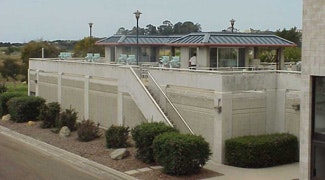
Digesters/Bio-Solids Treatment
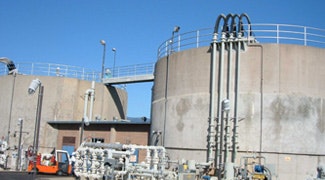
The solids (sludge and scum) removed from the wastewater during the treatment processes contain valuable nutrients, which are recaptured and turned into beneficial biosolids.
The primary solids are mixed with secondary solids collected through the process and are thickened by two mechanical sludge thickeners. They are then stabilized in three large, heated anaerobic (no oxygen) digester tanks for about 30 to 35 days. Microorganisms continue to break down the solids and consume harmful elements. This digestion process produces methane gas, which is captured and used to heat the digesters, creating a closed-loop system. The temperature in the digesters is about the same as of that of the human body, and they function much like our digestive systems.
The digested solids are then further treated in two stabilization basins (lagoons) for, six months to two years. These solids are then harvested out to drying beds where they are dried in several stages to kill off any remaining bacteria. A portion of these digested solids is sent to two mechanical screw presses where the solids are dewatered and then trucked off-site for land application. The harvested product has a dark, earthy color, is completely dry, nearly odorless.
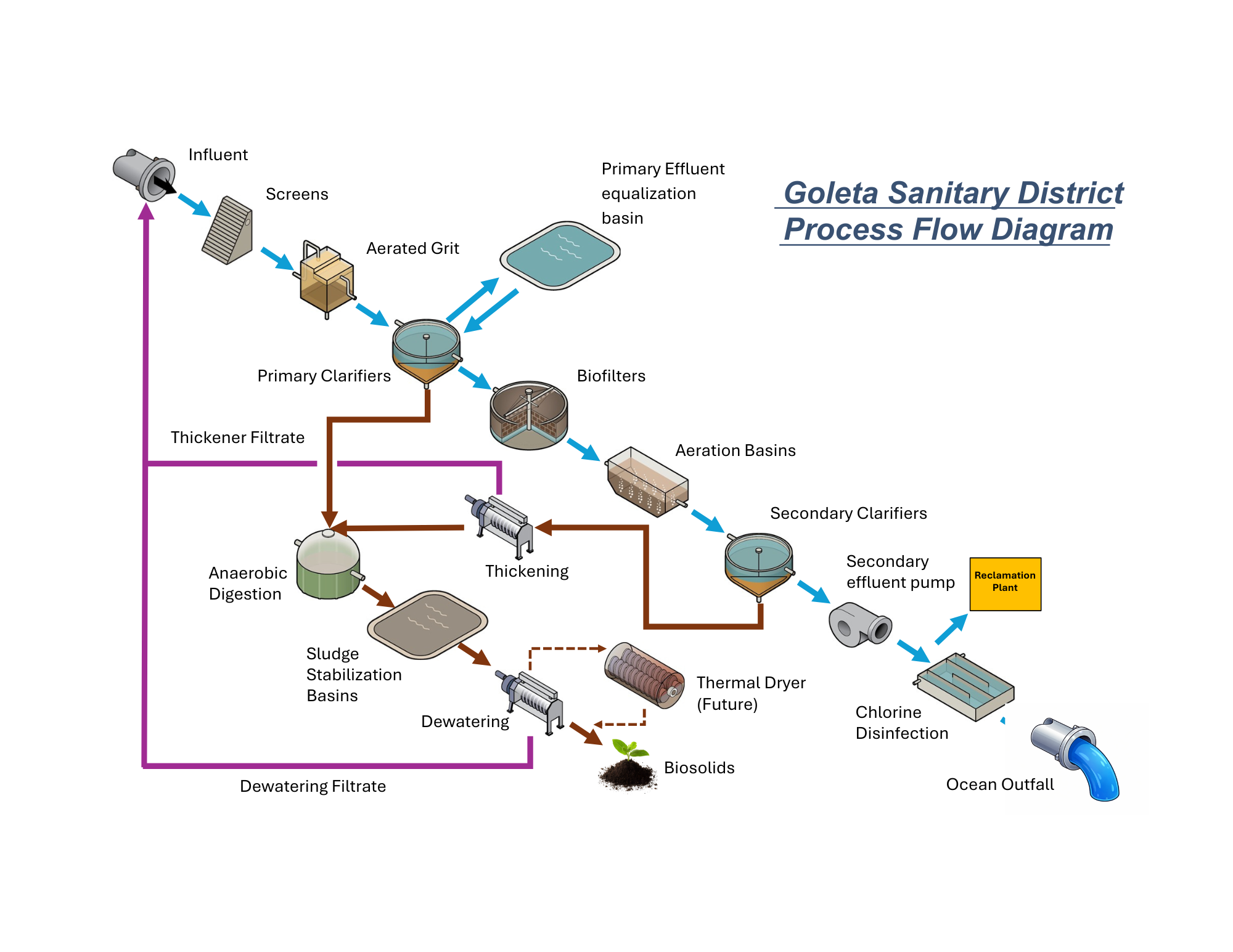
See the diagram below, which closely replicates the wastewater and solids treatment processes here at GSD.
Process Diagram